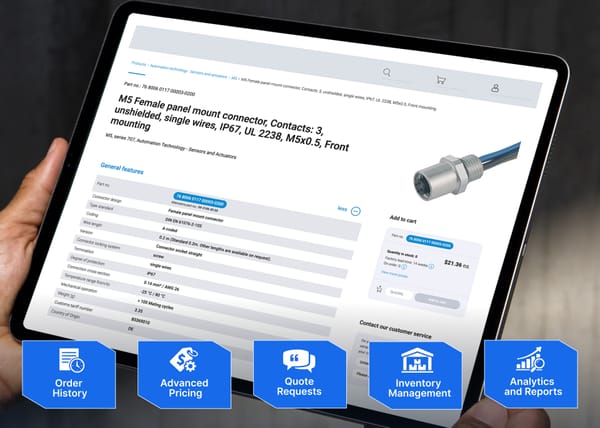
From Manual PIM and Email Quotes to Scalable B2B eCommerce in 2 months, without fuss and within budget
- e-Commerce integration without rebuilding the existing TYPO3 website
- Automated product and pricing updates from PIM (no more manual maintenance)
- Real-time or near real-time stock synchronization
- Tiered / quantity-based pricing visible to customers as they browse
- Quote request flow for large quantities (instead of email back-and-forth)
- B2B-ready search experience (fast, relevant, typo-tolerant)
- Checkout + customer account area with the same UI as the leading site
- A rollout approach designed to protect SEO and avoid downtime
When a company already has traffic, strong SEO, and a stable content platform, rebuilding the website is rarely a business necessity. Yet this is precisely what many vendors propose when asked to integrate PIM, ERP, or B2B eCommerce features into an existing site.
In this case, the client was a manufacturing business with a well-established TYPO3 website, steady daily traffic, and a mature internal process for content updates. Selling a new website would have been easy. It also would have been expensive, slow, and risky.
Instead, we focused on what was actually slowing down growth: manual data workflows and B2B ordering friction.
The Real Problem: Processes That Don’t Scale With Sales
The bottlenecks were not on the marketing side.
Product data had to be imported and maintained manually. Stock information was not refreshed often enough. Large orders required email-based quote requests. Each of these issues affected a different part of the business, but the outcome was the same: slower sales cycles, higher operational costs, and missed high-margin opportunities.
The typical answer is predictable:
“Your website can’t support this. You need a new one.”

From a business perspective, that often means paying twice: first for the rebuild, then again for integrations and operational workarounds that should have been avoided from the start.
A Different Approach: Headless eCommerce Solutions Instead of a Rebuild
Rather than replacing a website that already worked, we proposed a headless e-commerce solution.

The principle was simple: keep TYPO3 as the content and SEO engine, and introduce Magento as a dedicated commerce backend that can handle the heavy lifting -pricing, stock, cart, checkout, accounts, and automation - without forcing a migration.
This is why open-source headless e-commerce can be a pragmatic choice for B2B: it enables modernization without turning your CMS into a custom commerce platform.
How Users Move Between the Two Sites (And Still See “Their” Prices)
This is the part many stakeholders worry about, so we designed the experience to feel like one website, not two stitched systems.
Here’s how it works in practice:
A visitor discovers products and content on the main TYPO3 site. Product pages remain SEO-friendly and follow the existing structure. When the website needs commerce-specific data such as tiered pricing, availability, or cart status, it requests that information from the Magento backend via API.
When a user logs in (or needs to access checkout/account functionality), they are taken to the Magento shop environment (typically on a subdomain). The key is that authentication and session handling are configured so the user’s identity is recognized consistently across both environments. Once authenticated, Magento can calculate and return the correct pricing and availability logic for that user and cart context.
From the user’s perspective:
- They browse on the main site as usual
- They can see accurate pricing/stock
- When they proceed to checkout or account pages, the transition is seamless
- They never feel like they “left” the website
From the business perspective:
- Pricing and cart logic stay centralized in one place
- frontend stays stable and SEO-safe
- No duplicated rules across systems
What Was Done on the TYPO3 Website
On the frontend side, the TYPO3 website remained fully intact.
Its structure, navigation, SEO logic, and editorial workflows were not changed. The marketing team continued working in the same environment and using the same publishing process.
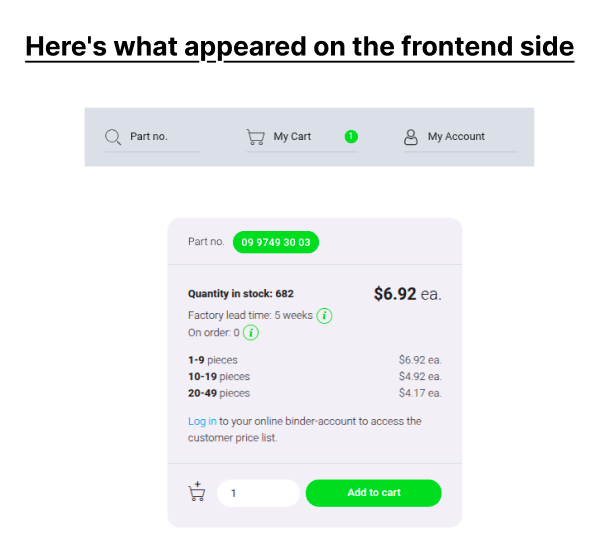
We extended TYPO3 with lightweight UI components that pull commerce data from Magento. That includes prices (including quantity-based tiers), stock status, and cart indicators. TYPO3 stays responsible for content, user journeys, and discoverability. Magento stays responsible for transactional truth.
What Was Implemented on the Magento Side
Magento was implemented as a fully decoupled commerce engine, embedded into the existing website through a headless, API-driven model.
The existing TYPO3 site remained the primary digital entry point for users, preserving SEO, structure, and established user journeys. Magento was deployed on a dedicated subdomain and configured to operate as a backend service rather than a standalone storefront. To ensure a seamless experience, cross-domain cookies were set up so users could authenticate once and immediately see pricing and availability based on their login status, regardless of which part of the site they were on.
Visually, the Magento environment was aligned with the main website. The same header, footer, and core UI elements were recreated so that checkout and account pages felt like a natural continuation of the TYPO3 site rather than a separate system. Non-essential Magento URLs were automatically redirected back to the main website to avoid UX dead ends and keep navigation consistent.
On the data side, Magento became the central point for all commerce logic and automation. Product data was synchronized daily from the PIM system, covering thousands of SKUs without manual intervention. Stock information was updated at short intervals to ensure ordering decisions were based on real availability rather than static data.
The frontend communicates with Magento entirely through APIs. Prices, stock status, cart updates, and cart retrieval are requested dynamically as users browse, ensuring that what they see on the website always reflects the current business rules defined in the commerce backend.
Magento also hosts the transactional parts of the customer journey. Shipping logic was integrated using established carrier solutions, while payments support common B2B and B2C scenarios, including credit cards, PayPal, and purchase order numbers. Checkout was optimized into a fast, one-page flow to reduce friction, especially for repeat buyers.
Search was treated as a revenue-critical feature rather than a cosmetic one. Magento’s search capabilities were enhanced with weighted attributes, synonym dictionaries, typo tolerance, and live suggestions, making it easier for buyers to find the right products in large catalogs.
For high-volume orders, an automated quote request flow was implemented directly within the buying journey. Instead of switching to email once quantity thresholds are reached, customers can request a quote in-context, keeping them engaged and significantly increasing the likelihood of conversion on large deals.
The entire setup runs in a containerized environment on cloud infrastructure, with performance, security, and monitoring handled at the platform level. This ensures the system is reliable under load, observable in production, and ready to scale without introducing operational complexity.
Platform & Infrastructure Setup
The solution was designed as a production-grade platform, not an experimental integration. Infrastructure choices were made to support reliability, scalability, and long-term maintainability, especially important for B2B environments with complex catalogs and ordering logic.
At the core of the system is Magento 2, used in an API-first, headless-friendly setup. Magento acts as the central commerce engine, handling pricing logic, cart behavior, checkout, customer accounts, and order processing, while remaining fully decoupled from the frontend.
The existing website runs on TYPO3, which continues to serve as the primary CMS, content layer, and SEO engine. The architecture is also compatible with WordPress-based frontends, making the approach transferable to other CMS environments without redesigning the commerce backend.
Search and product discovery are powered by Elasticsearch, configured to handle large B2B catalogs with weighted attributes, synonyms, typo tolerance, and fast response times. This ensures buyers can efficiently navigate complex product structures without performance degradation.
From an infrastructure standpoint, the entire platform is deployed on AWS using Docker, allowing services to be isolated, scaled independently, and updated safely. This setup supports predictable performance under load and reduces operational risk during deployments.
Cloudflare is used as an additional layer for CDN, performance optimization, and security. It improves global response times, protects against common attack vectors, and adds network-level resilience, particularly important for US-based traffic.
System health and stability are actively monitored using NewRelic and Sentry. Performance metrics, errors, and anomalies are tracked in real time, enabling fast detection and resolution of issues before they impact users or revenue.
For backend data flows, a custom XML-to-Magento importer connects ERP systems to the commerce platform in a controlled, observable manner. This avoids brittle integrations and ensures that product, pricing, and operational data remain consistent.
Shipping logic is handled via ShipperHQ, providing flexible carrier integrations and accurate rate calculations for B2B orders. Payment flows support common business scenarios, including credit cards, PayPal, and purchase order (PO#) payments, without forcing additional manual checks during checkout.
Together, this infrastructure forms a stable and extensible foundation that supports headless B2B eCommerce at scale without tying the business to a single frontend or forcing costly rebuilds as requirements evolve.
Headless E-commerce Architecture Diagram
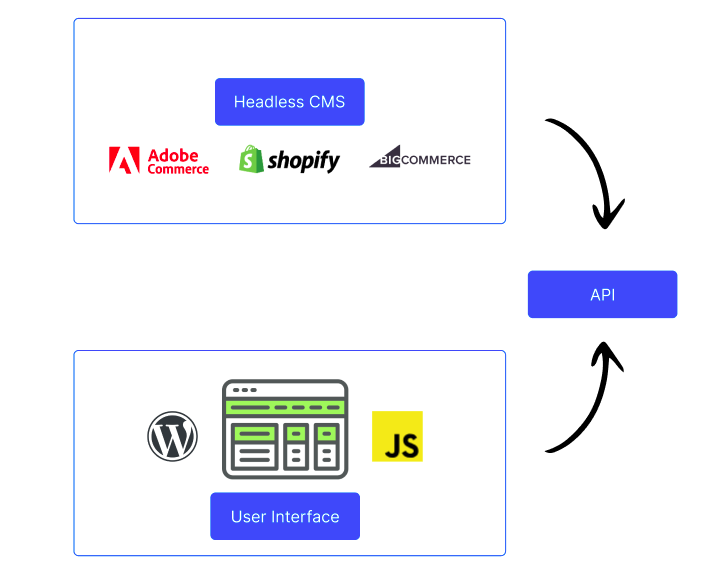
- TYPO3 = content + SEO + product discovery.
- Magento = pricing + cart + checkout + accounts. PIM/ERP feeds Magento automatically.
Why Headless E-commerce Magento Was Chosen
Magento was selected not because it is fashionable, but because it reduces risk and time-to-value in B2B.
For headless B2B ecommerce, Magento provides:
- Built-in B2B capabilities and mature ordering logic
- A large ecosystem of modules that solve everyday needs without rebuilding everything from scratch
- strong customization options where the business truly needs differentiation
- An API-first approach that fits naturally into a headless model
In other words, instead of creating a fragile custom commerce layer inside a CMS, we used a proven commerce platform exactly for what it does best - and connected it cleanly to the existing site.
Results After Automation
Once the system was live, the impact was measurable.
Manual product and pricing maintenance dropped by approximately 40–80% through automated PIM synchronization. Pricing and stock-related order errors were reduced by 20–40% thanks to real-time validation.
Most notably, automating the quote request process contributed to a 20–50% increase in the capture of high-volume opportunities, because large buyers no longer had to switch to email, wait for responses, or restart the process.
Growth became scalable again without proportional growth in operational overhead.
Headless E-commerce Benefits in Practice
The main benefit of this approach is not technical elegance. It is control.
The business keeps its existing website and traffic engine. Commerce logic becomes centralized, auditable, and easier to evolve. Operations stop scaling linearly with revenue because the system, not people, does the repetitive work.
If your website already attracts traffic and supports your brand, rebuilding it to solve backend inefficiencies is often the wrong move.
When manual PIM updates, tiered pricing complexity, and email-based quotes are the real blockers, headless B2B eCommerce provides a faster, safer, and more cost-effective path forward.
Sometimes, being on the client’s side means choosing the solution that makes the most business sense, not the one that sells the biggest rebuild.