About the Client
The client is a globally operating industrial manufacturer specializing in high-precision pumping systems and fluid-handling equipment. The company serves more than 24,000 active B2B customers across manufacturing, chemical processing, food production, and engineering industries.
With decades of market presence, the client is recognized for engineering excellence, reliability, and long product lifecycles. Its portfolio includes technically complex equipment as well as an extensive spare parts catalog that plays a critical role in service, maintenance, and recurring revenue.
The client's main challenges
Despite strong product innovation, the client’s digital sales and ordering processes had not evolved at the same pace. The existing website functioned primarily as an informational platform and did not support modern B2B buying behavior, self-service, or transactional workflows.
Facing increasing competition and changing customer expectations, the company set out to modernize its digital presence and establish a scalable B2B commerce foundation tightly integrated with its ERP system.
Business Challenge 1: Manual Ordering Was Blocking Scalability
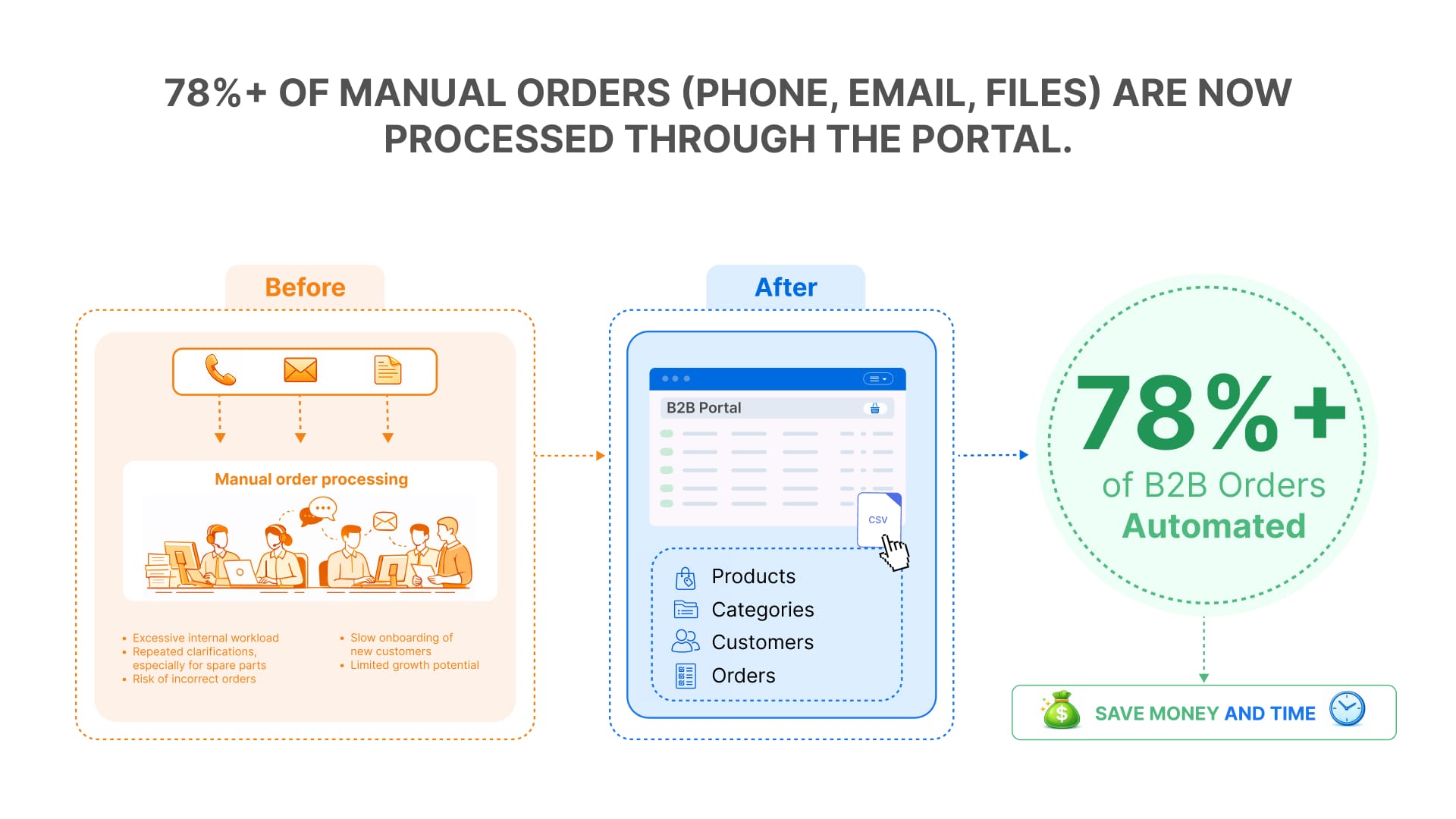
Before the project, the majority of B2B orders were placed via email, with a smaller portion handled by phone. Orders were manually processed and re-entered into the ERP system, creating several structural problems:
- High internal workload for order handling
- Frequent clarification cycles, especially for spare parts
- Increased risk of incorrect orders
- Slow onboarding of new customers
- Limited scalability as customer volume increased
Spare parts ordering was particularly problematic. Identifying the correct part often required back-and-forth communication between customers and internal teams, slowing down service and increasing operational costs.
The client needed to shift ordering behavior toward self-service while still supporting existing customers during the transition period
Business Challenge 2: Lack of Scalable Multi-Language Content Architecture
Although the company operates across multiple European Union markets, its digital presence was not fully aligned with the needs of an international B2B audience.
At the start of the project, the website supported interface-level translations, but core commercial content remained available in only one language (German). Product attributes, technical specifications, and descriptions were not localized, creating several business limitations:
- Customers in non-German-speaking countries had to interpret technical product data in a foreign language
- Sales teams were forced to compensate with manual explanations and documentation
- Marketing and SEO efforts were restricted to a single language and market
Content updates require ad-hoc, manual handling without a structured publishing workflow
One of the project's strategic goals was to establish a fully multilingual B2B platform, initially supporting German, English, and French, with the ability to expand further without architectural changes.
This was not only a user experience improvement but also a growth initiative:
- Better usability for international customers
- Increased organic traffic from multiple EU markets
- Higher conversion rates driven by localized product content
The client needed a solution that would support continuous content updates, structured translations, and long-term scalability across languages and regions.
Technical Challenge 1: ERP Integration Without APIs
The client’s ERP system represented the most significant technical constraint in the project:
- No modern APIs available
- XML-based data exchange only
- File-based synchronization via FTP
- Strict formatting and validation rules
- The ERP environment could not be modified or extended

The ERP system remained the single source of truth for products, pricing, inventory, customers, and orders. Magento had to fully adapt to the ERP, not the other way around, while ensuring reliability, data consistency, and compliance.
Delivery Challenge 1: High Scope, Fixed Timeline, International Team
The project was delivered under conditions that significantly increased the complexity of delivery.
In addition to a fixed timeline and broad scope, the client-side organization involved an international, cross-functional team distributed across multiple business units and technical domains.
We worked closely with:
- business stakeholders responsible for sales, service, and operations,
- technical teams maintaining the legacy ERP system,
- decision-makers and subject-matter experts across different departments.
A major challenge was that most client-side stakeholders did not communicate in English fluently. Apart from the CEO and a small part of the ERP development team, communication had to account for language barriers and different ways of expressing requirements and concerns.
As a result, nearly 90% of communication with the client team was conducted via written channels, email, and chat rather than live meetings.
How we addressed the delivery challenge
To reduce ambiguity and risk before committing to scope and estimates, we took a structured, proactive approach:
- Conducted several in-depth walkthrough calls to demonstrate how the system would work in practice, down to operational details
- Collected and documented all client questions, assumptions, and edge cases
- Prepared a detailed implementation plan, including alternative scenarios and decision points
To further improve alignment and understanding, we:
- Translated the full implementation plan and project scope into the client’s native language
- Used clear, visual explanations instead of abstract descriptions
- Ensured all key decisions were documented and easy to revisit
Execution approach
Delivery was organized into short, iterative sprints, with a strong focus on early visibility:
- Functional results were demonstrated frequently
- The client could clearly see progress and confirm that the project was on schedule
- When change requests or alternative ideas emerged, we explained their impact on timelines, scope, and dependencies, allowing the client to consciously decide whether to:
- implement the change immediately,
- postpone it to a later phase,
- or keep the original approach.
Documentation and enablement
The portal functionality was fully documented, and we complemented written documentation with:
- short instructional videos explaining how to use key portal features,
- clear onboarding materials for internal teams and customers.
This ensured that knowledge was not locked in meetings, emails, or individual team members’ heads, but available in a reusable, accessible format.
Key delivery principle
The most important factor in successful delivery was making the expected outcome visible at the right time.
We consistently:
- surfaced risks early and proposed solutions before issues escalated,
- stayed continuously available for clarification and alignment,
- delivered information in formats that were easy to consume asynchronously,
- and transformed discussions into structured documents and videos that could be reviewed at any time.
This approach allowed the project to move forward predictably despite language barriers, distributed teams, and high organizational complexity.
What We Did
The project was delivered within 5 months by a compact team consisting of:
Within this timeframe, the team had to deliver:
- a complete website redesign,
- a full B2B e-commerce platform,
- multi-language and multi-region setup,
- deep ERP integration,
- spare parts ordering workflows,
- SEO-ready content architecture,
- and a controlled enterprise-grade go-live.
Managing scope, priorities, and risk required a highly structured delivery approach.
Solution 1: Built a Scalable B2B Self-Service Portal Integrated with ERP
We designed and implemented a custom B2B self-service portal on Magento 2, with a strong focus on scalability, ERP alignment, and international expansion.
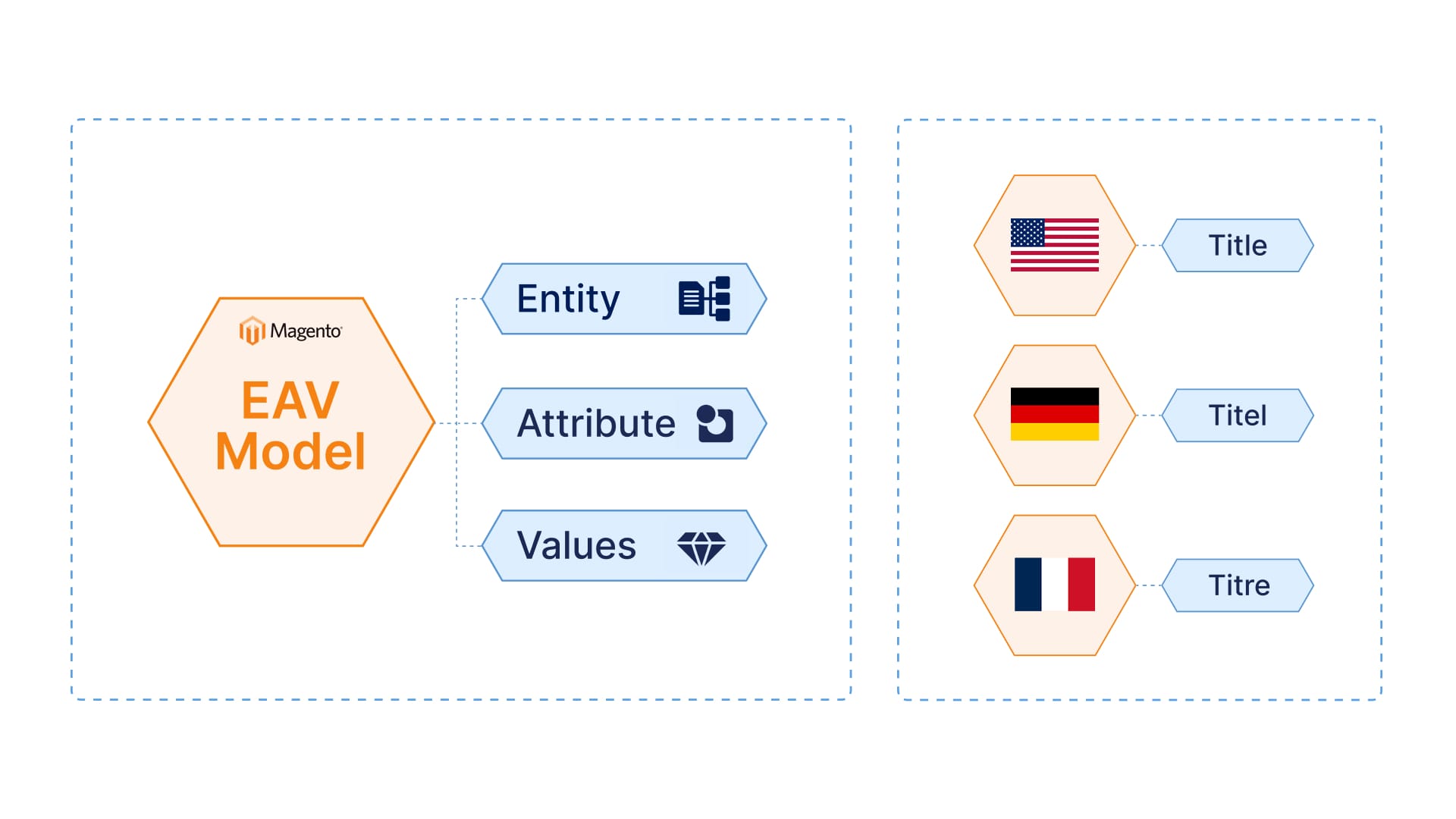
A key architectural decision was selecting a platform with a native EAV (Entity-Attribute-Value) data model, which enabled us to address the multi-language challenge at its core.
How we addressed the localization challenge:
- Implemented a multi-store, multi-language architecture supporting country-specific content, assortments, pricing, and legal requirements
- Leveraged Magento’s EAV model to enable unlimited product attributes, each fully translatable into any number of languages
- Structured product data so that attributes, descriptions, and technical specifications could be localized independently
- Ensured ERP remained the single source of truth while Magento handled language-specific presentation layers
This approach solved the immediate requirement of supporting three languages while keeping the architecture fully open for future expansion.
The platform is not limited to a fixed set of languages and can scale to any number of markets without refactoring or changes to the data model.
As a result, localization became a native capability of the platform, rather than an afterthought or a manual workaround.
The platform was designed to scale globally without architectural rework.
Solution 2: Implemented Enterprise-Grade B2B Ordering Features
To replace email- and phone-based ordering, we delivered a comprehensive set of B2B-specific workflows designed for professional buyers who already know what they need and expect speed, accuracy, and repeatability.
We solved this challenge in the following way:
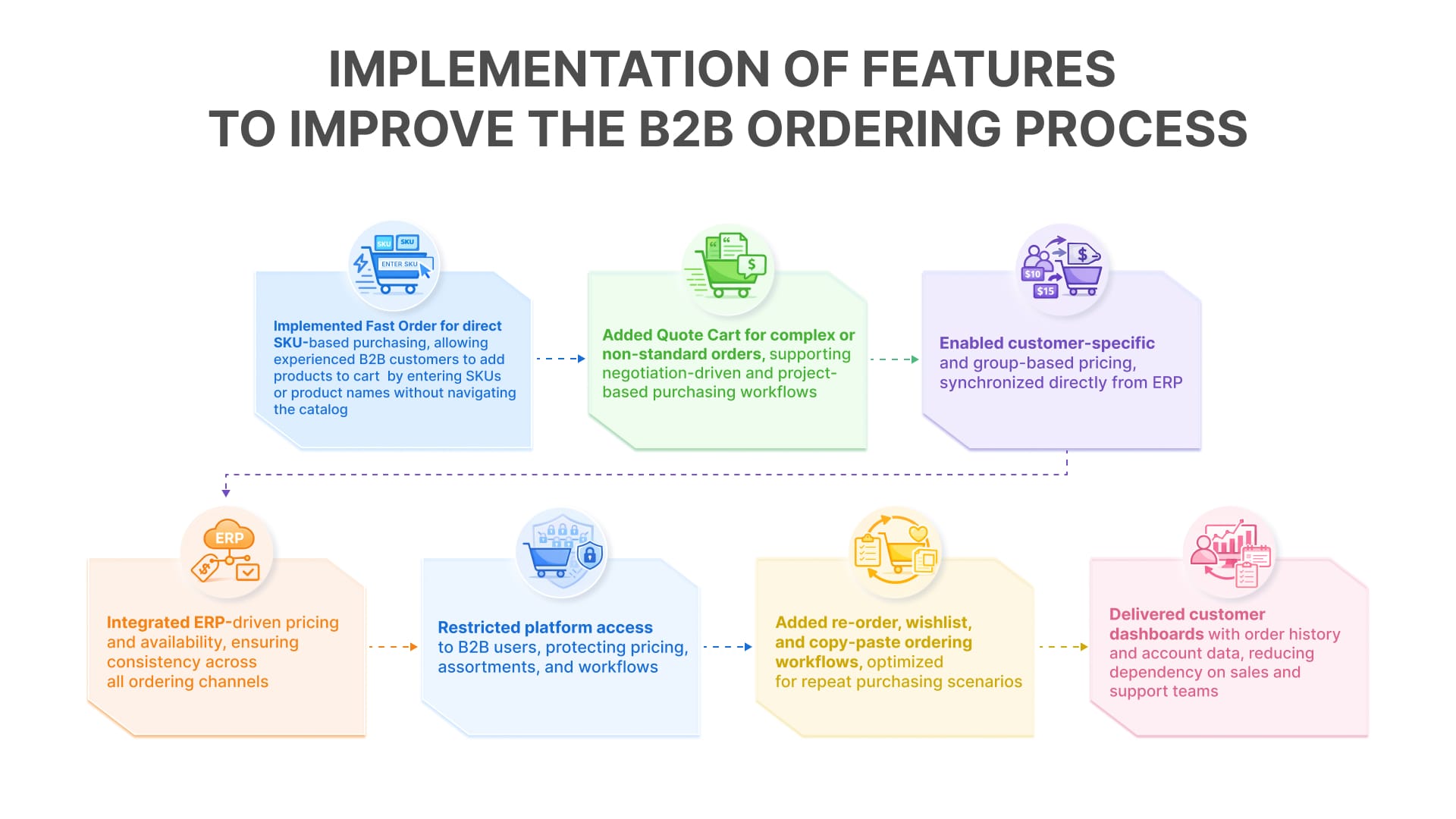
- Implemented Fast Order for direct SKU-based purchasing, allowing experienced B2B customers to add products to cart by entering SKUs or product names without navigating the catalog
- Enabled instant AJAX-based SKU validation and product lookup
- Supported bulk input of multiple SKUs in a single action
- Added file upload (SKU + quantity) to process long order lists in seconds
- Fully aligned Fast Order logic with ERP-driven pricing, availability, and packaging rules
- Added Quote Cart for complex or non-standard orders, supporting negotiation-driven and project-based purchasing workflows
- Enabled customer-specific and group-based pricing, synchronized directly from ERP
- Integrated ERP-driven pricing and availability, ensuring consistency across all ordering channels
- Restricted platform access to B2B users, protecting pricing, assortments, and workflows
- Added re-order, wishlist, and copy-paste ordering workflows, optimized for repeat purchasing scenarios
- Delivered customer dashboards with order history and account data, reducing dependency on sales and support teams
One of the most critical components of this transformation was Fast Order, built specifically to support SKU-driven purchasing behavior common in industrial and spare parts sales.
Fast Order: Direct SKU-Based Purchasing at Scale
In the client’s legacy process, experienced customers typically sent long lists of SKUs and quantities via email or Excel. Sales teams then manually validated and re-entered this data into the ERP, creating delays and a high risk of errors.
To eliminate this bottleneck, we implemented a Fast Order module on top of Magento 2, designed to mirror and automate real-world B2B purchasing behavior.
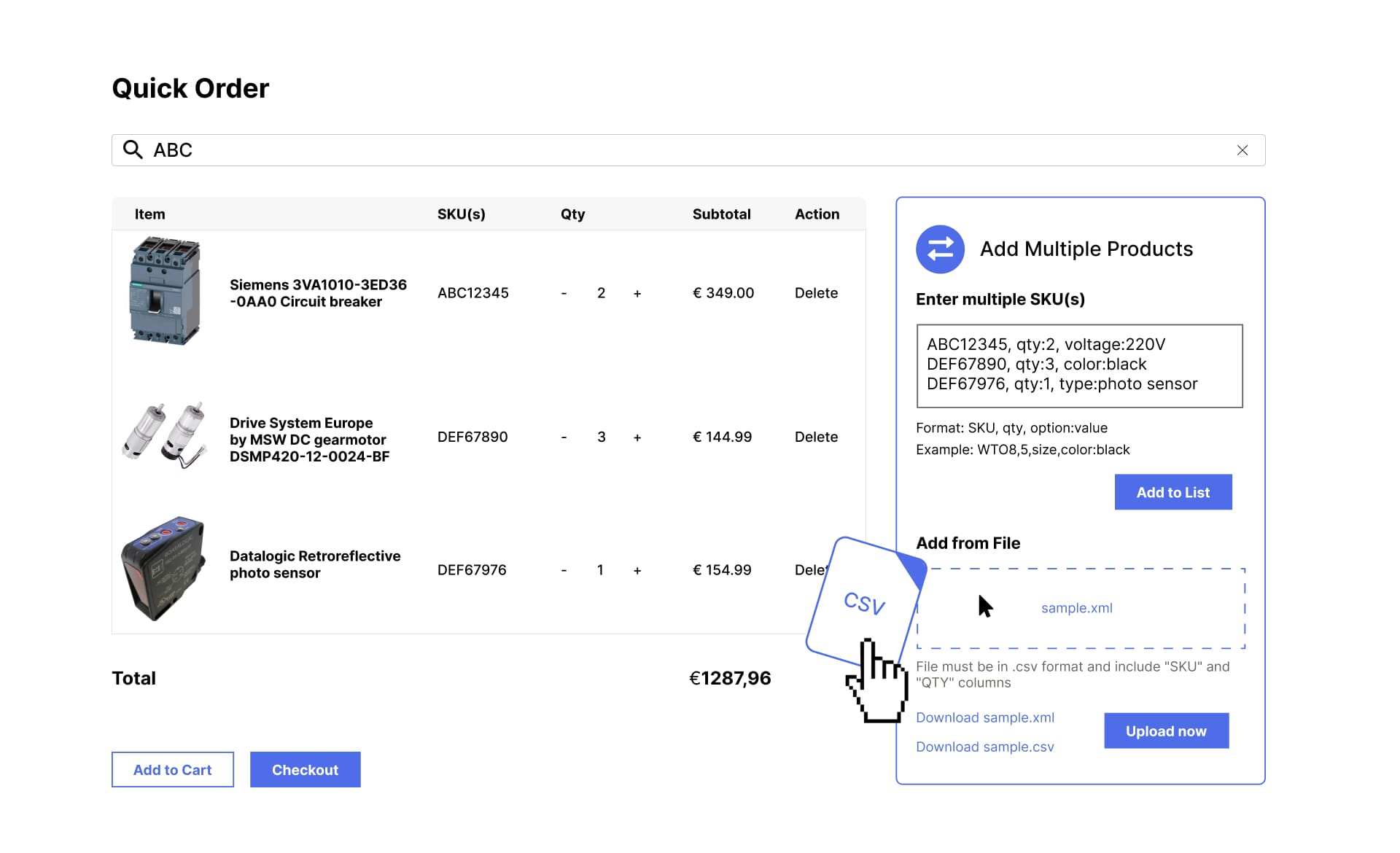
The solution enables customers to:
- Add products directly to the cart by entering SKUs or product names, without navigating the catalog or product pages
- Use instant AJAX-based product search to validate SKUs and avoid incorrect entries
- Insert multiple SKUs at once and add them to the cart in a single action
- Upload files (e.g., CSV or Excel-style lists) containing SKU + quantity combinations to quickly prepare large orders
How we implemented it
From a technical perspective, the Fast Order feature was tightly integrated into the existing ERP-driven data model:
- Product availability, pricing, and packaging rules are validated in real time against ERP-synchronized data
- SKU validation happens before products are added to the cart, reducing invalid or incomplete orders
- The module was optimized for large order volumes typical for spare parts and repeat purchasing scenarios
- UX was intentionally minimal, focused on speed and efficiency rather than discovery or marketing
- This approach ensured that Fast Order did not operate as a standalone feature, but as a first-class ordering workflow fully aligned with ERP logic and B2B business rules.
Business impact
Fast Order fundamentally changed how experienced customers interact with the platform:
- Long SKU lists that previously required email or Excel uploads can now be processed directly by customers
- Order preparation time was significantly reduced for both customers and internal sales teams
- Manual re-entry and clarification cycles were eliminated
The portal became the primary channel not only for new users, but also for long-term, high-volume customers
As a result, Fast Order played a key role in shifting ordering behavior from manual channels to self-service, while preserving the efficiency expectations of professional B2B buyers.
These features transformed ordering from a manual process into a structured, repeatable workflow.
Solution 3: Made Spare Parts Ordering a Central Function of the Store
Spare parts sales were treated as a core business function rather than an add-on.
We solved this challenge in the following way:
- Designed simplified spare parts product pages
- Implemented structured attributes and variants for accurate identification
- Added multiple access points to spare parts across the store
- Enabled visual and category-based identification flows
This allowed customers to identify and order spare parts faster, more accurately, and with minimal support involvement.
Solution 4: Engineered a Robust ERP Integration Without ERP Changes
To overcome ERP limitations, we built a custom integration layer.
We solved this challenge in the following way:
- Implemented automated XML ingestion for products, prices, and stock
- Built custom validators and converters for ERP-specific formats
- Added file-monitoring and alerting for synchronization issues
- Extended Magento APIs to support ERP order and customer consumption
- Ensured GDPR-compliant logging and monitoring
All synchronization was achieved without modifying the ERP system.
Key Results and Business Value
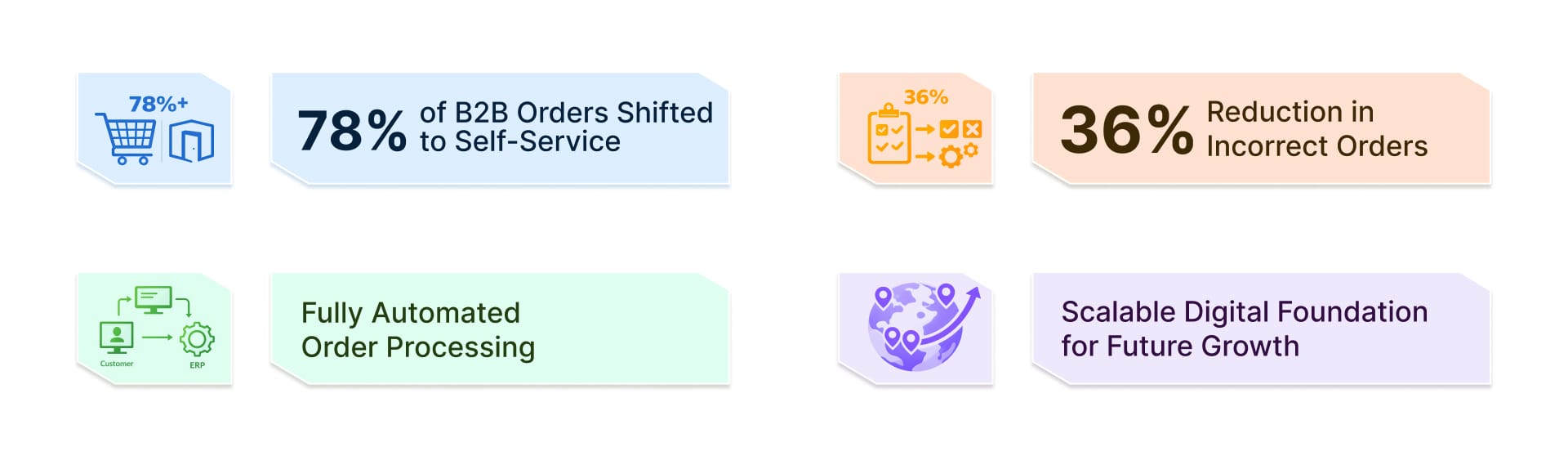
#1: 78%+ of B2B Orders Shifted to Self-Service
Within 6 months after launch, more than 86% of all B2B orders were placed through the portal.
Email and phone ordering remained primarily for legacy customers, while new customers were onboarded portal-first.
#2: Fully Automated Order Processing
Orders now flow end-to-end:
- Customer → Portal → ERP
- No manual re-entry
- ERP-driven pricing, stock, and packaging logic
This eliminated major operational bottlenecks and reduced internal workload.
#3: 36% Reduction in Incorrect Orders
Thanks to structured data, improved UX, and spare parts identification flows:
- Clarification cycles dropped
- Incorrect orders decreased
- Customer confidence increased
#4: Scalable Digital Foundation for Future Growth
The new platform supports:
- new markets: UK, FR, USA, Canada and languages,
- additional product lines,
- future SEO and marketing initiatives,
- long-term digital sales growth.
Features Delivered
#1: Core B2B Commerce
- Product catalog and PDP templates
- Cart, checkout, customer accounts
- Re-orders and wishlists
#2: ERP Synchronization Layer
- XML-based product, price, and stock import
- Order and customer export to ERP
- Monitoring and validation
#3: B2B Ordering Enhancements
- Fast Order
- Quote Cart
- Customer-specific pricing
- B2B access control
#4: Spare Parts & UX Modules
- Spare parts identification flows
- Industry- and application-based navigation
- Download center and technical documentation
#5: Multi-Language & Localization Framework
- Multi-store, multi-language architecture
- Translatable product attributes and descriptions
- Localized technical content per market
- Scalable language expansion without architectural changes
The Technology We Used
- Magento 2 (Open Source)
- Custom XML-based ERP integration
- Dockerized cloud infrastructure
- CDN and performance monitoring
- ERP-driven pricing and inventory
Final Note
This project demonstrates how a legacy industrial manufacturer can transition from manual, email-based ordering to a modern, automated B2B self-service model, without replacing its ERP or disrupting existing operations.
In 5 months, the client laid the foundation for scalable digital growth while significantly improving operational efficiency and customer experience.